
By Alexander Wissel, Executive Editor
December is a natural moment to step back, take inventory, and acknowledge the contours of the year ahead. In grocery and retail, the biggest shift isn’t holiday traffic or Q4 promotions. It’s the accelerating impact of AI and LLMs.
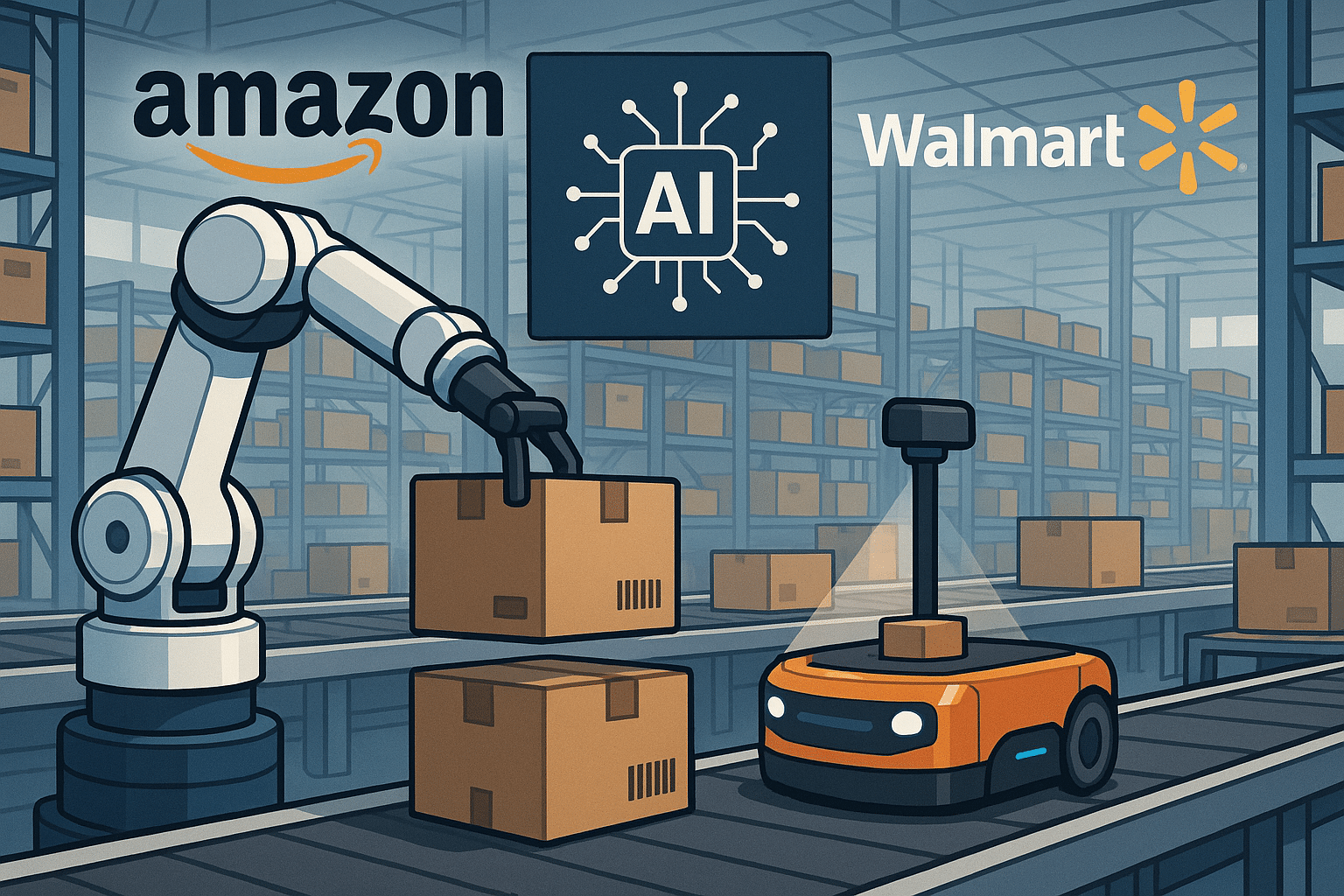
Two of the biggest retailers, Amazon and Walmart, have quietly chosen opposite strategies that may define the next decade of retail. And while they can alter course at any time, I’d wager that these seemingly insignificant decisions will be talked about five and 10 years from now to discuss the winners and losers of the LLM wars.
It’s worth quickly understanding that while we use the term AI to imply artificial intelligence, what we’re talking about is an LLM: a large language model. LLMs like ChatGPT and Gemini are all the rage… but we’ve actually used these for years. Every time your phone or Gmail suggested a sentence or next word to type, you were using, testing, and even training an LLM.
These programs are now robust enough to communicate easily, reason through complex tasks, and contribute to workflows. It’s a delightful tool – but one that should be used carefully. If everything you do can be replaced by an LLM, most likely one day, that task and you will be.
On the flip side, AGI (artificial general intelligence) is the name given to what we collectively think of as artificial intelligence. This is the independent intelligence that acts with agency and can problem solve like a human – or better. To anyone’s knowledge, we haven’t achieved this technological milestone… yet.
But LLMs are already altering how customers search, shop, and decide. December is the right time to admit: next year’s growth plans must reflect this.
The Future Isn’t All Online — But the Customer Is
Capital One’s Online Research Study tells us that in 2024, 13.7 percent of grocery purchases were online. A staggering $219.3 billion in sales. By 2026 they expect that number to climb to 19% of total grocery sales.
This isn’t a channel expansion. It’s a behavioral shift. For years, pickup and delivery were defensive moves: if you didn’t offer them, customers would simply go elsewhere. Now, they are a fundamental part of the sales engine. Let’s now add the mechanics of online discovery which have changed just as quickly.
Since mid-2024, online search click-through rates have plummeted. That’s 61 percent for AI previews and 68 percent from paid search. That’s a massive drop. And the traffic isn’t coming back. It’s migrating to platforms like ChatGpt, Gemini and even Tik Tok.
A chief marketer I admire recently told a room full of vendors to get on TikTok. He wasn’t wrong. Consumers aren’t climbing down the familiar ladder into the pool; they’re cannonballing in from social content and AI suggestions.
That’s why everyone is suddenly saying “omnichannel” like it’s a secret handshake. It’s not about channels. It’s about entry points.
Impulse buying used to be endcaps. Now it’s: “recommend a quick dinner under $12.” Or, “show me a kid-friendly lunch plan.” It’s no accident that Giant Food is partnering with cashback app Upside to boost digital basket growth. In an LLM/ AI-shaped world, impulse must be engineered differently.
Fortress Amazon vs. Metropolis Walmart
Which brings us to December’s biggest strategic divergence. Walmart is opening its borders while Amazon is closing its gates. Walmart has allowed LLMs to index its products. Amazon has explicitly blocked scraping.
The difference is already measurable: Walmart.com receives more than 20 percent of its referral traffic from ChatGPT, while Amazon receives less than 3 percent. The irony: the company that built e-commerce through openness is now protecting its walled garden. Meanwhile, Walmart — the historic fortress of brick-and-mortar — is behaving like a digital insurgent.
Retail media explains a big part of it. Amazon commands 76.2 percent of all retail media ad spend. That’s All with a capital A. With that kind of dominance, protecting ad inventory makes sense.
But strategically? As we close the year out, this looks like the first real fork in the road. It feels so inconsequential and yet I believe this will have major impacts on these firms and the e-commerce landscape for all of us.
Walmart’s new CEO John Furner seems like just the guy to take up this mantle. By all accounts he’s an operator with a real understanding of applying technology to the business. He was instrumental in growing their Walmart Connect ad platform and Walmart+, both of which seem to be pages from the Amazon playbook.
At the time of this writing the Walmart quarterly report was just hitting the newsstands. Make no mistake: it reads like it’s an e-commerce-first company. WMT stock has risen more than 5 percent over the past quarter, and I’d expect that to continue.
Fulfillment: The Ultimate Retail Trench Warfare
Behind the noise, fulfillment remains the true battlefield. Kroger is shuttering automated fulfillment centers in Maryland, Florida, and Wisconsin to re-center focus around its stores. What looks like poor planning and questionable execution hides a hard truth: it takes years to build systems and operating efficiencies in digital sales.
Walmart only began turning a profit on grocery fulfillment in the first quarter this year… And they began fulfilling grocery orders in 2013! This is trench warfare. Expensive. Slow. Necessary.
Most of our readers are not Amazon or Walmart. We don’t get to fight in the sky. We’re closer to WWI miners: head down, steady digging, hoping the tunnels we create will lead somewhere productive. I think that’s true for almost any business, especially the industries I’ve dealt with.
The ‘fog of war’ created by LLMs and new AI opportunities hides a shift that our industry may not even be aware of yet. You are not a warehouse, you are a brand platform. Omnichannel isn’t just about distribution and ad channels, it’s omni-communication and reaching your customers where they are.
Private label isn’t just gross margin control. It’s a powerful tool for identity, and retention. Your job is curation and creating a unique experience. Your advantage is customer connection. Your moat is loyalty – not logistics.
In December, as the dust settles on a tumultuous year – and I close out my first year in the business – this is the one takeaway that I find most important: retailers must invest in their brand and those that they own, not just promote the brands that rent space.
A Final Note
Phil Lempert has a great breakdown this month of the biggest themes this year, including a few I’d forgotten about. Next month, we’ll be looking ahead to what 2026 has in store for us.
We’ve created our free Private Label & Innovation Playbook because private label increasingly defines retailer differentiation and long-term profitability. It’s part of Food Trade Today, our new weekly intelligence brief built from your feedback and requests.
If you haven’t subscribed, you can do so on our website. And feel free to tell us what you want to see next. I believe that December is for reflection, and we’re building next year’s coverage around what matters most to you.


