
by Greg Madison
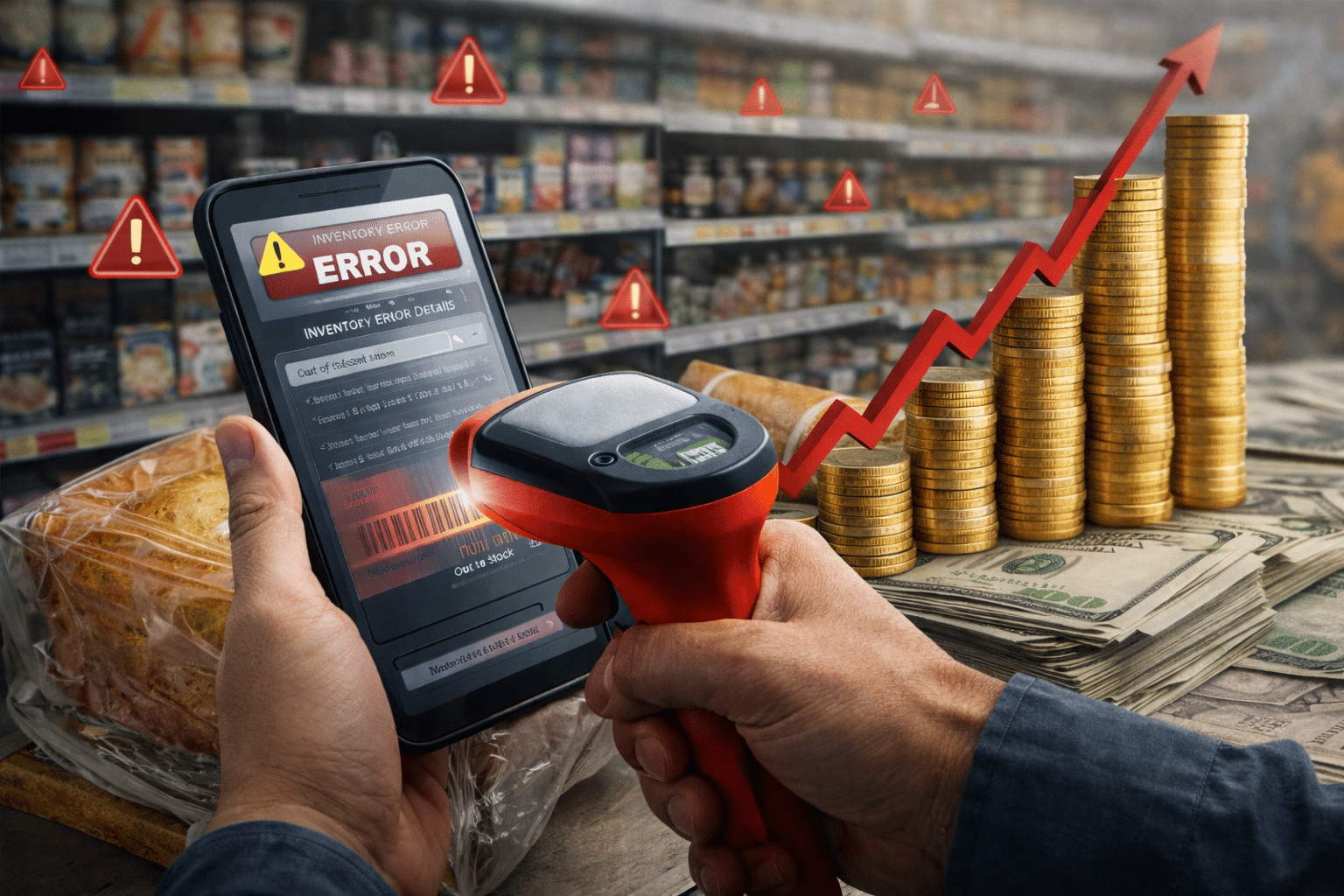
Sometimes it feels like grocery retail runs on “exceptions.” I mean the substitutions, the system overrides, the manual fixes – all the one-off decisions made in the moment to keep a customer happy or a store moving.
Individually, these moments feel harmless, even necessary. Collectively, though, they can start to become an operating model.
And that’s where the massive costs tend to lurk. And I do mean massive.
IHL reports that out-of-stock situations alone have been estimated to cost North American grocery retailers nearly 6% of total sales through lost purchases and substitution effects. Pricing disconnects, another exception, are estimated to cost North American grocery retailers $4.8 billion annually.
Most retailers still describe exceptions as “edge cases.” But there’s some evidence out there, which we’ll look at shortly, that suggests they’re becoming routine, driven less by “preference” or the “needs of the moment” than by data gaps, labor pressure, and systems that don’t quite reflect store reality.
When exceptions move from occasional to habitual, they quietly drain labor, distort data, and mask deeper execution problems.
Start with the data – or lack thereof. A recent analysis of grocery and retail operators found that roughly 65% of grocers lack access to real-time supply chain data, even as a large majority say such visibility is critical to daily decision-making . When inventory data is delayed, incomplete, or unreliable, store teams do what they’ve always done: they improvise. They substitute. They override. They fix it manually. They make an exception.
According to one survey of retail execs, 94% of them said they were “excellent” or “very good” at leveraging data for decisions, but nearly all of them acknowledged ongoing problems with fragmented, even inaccurate data that impedes execution.
The shopper in the aisles feels this, too. According to some omnichannel studies, just 29% of shoppers reported experiencing a “truly consistent” journey across channels. You can take that to mean around 70% of customers encounter substitutes, out-of-stocks, or mismatches between what’s shown online and what sits on the shelf.
Exceptions at every turn! It’s a tough problem and, as we’ve seen, an expensive one. But there are some solutions at hand.
Let’s dive deeper into the problem on the way toward the “light at the end of the tunnel”…
The Labor No One Budgets For
Every exception consumes labor, just not in a way that shows up neatly on a report. A substitution requires time to search, decide, and, often enough, communicate with the shopper. An override requires a supervisor. A manual inventory adjustment requires reconciliation later. Multiply that by dozens of incidents per day, per store, and exceptions quietly become one of the largest untracked labor drains in the operation.
This matters because grocery margins remain thin, typically in the low single digits; there’s little room for invisible inefficiency . Exception labor is also reactive. It spikes during peak hours, promotions, weather events, and staffing shortages – the moments when stores can least afford friction.
Ask team members where their time goes, and the answer is rarely “executing the plan.”
It’s fixing what wasn’t supposed to break.
When “Flexibility” Starts Breaking the System
Retailers often justify exceptions as good customer service and, on the surface, it can be. If an item isn’t available, substitute. If a price scans incorrectly, honor it. If the system says the inventory is there but the shelf is empty, override and move on.
Each decision is reasonable – no manager worth their salt would say otherwise. The problem is what happens when these actions stop being rare.
When exceptions become routine, behavior shifts. Associates learn that the system can’t be trusted. Managers prioritize speed over accuracy. Digital teams add layers of complex substitution logic. Merchants pad forecasts to protect availability. Operations adds labor “just in case.”
And taken as individually, none of this looks like failure. It actually looks like adaptation and resilience.
But adaptation has a cost structure, and most retailers aren’t measuring it.
Exceptions Poison the Very Data Meant to Fix Them
Here’s the paradox: the more exceptions a retailer allows, the worse its data becomes, and the harder it is to solve the underlying problem.
Substitutions mask true out-of-stocks. Overrides hide pricing errors. Manual inventory corrections break the feedback loop replenishment systems rely on. Over time, “smart” systems learn from, frankly, compromised signals.
The result is a most un-virtuous cycle. Poor data creates more exceptions. More exceptions further degrade data quality. Eventually, no one believes the numbers, and decision-making becomes defensive.
That gap between executive confidence and operational reality is well documented. As we saw earlier, a retail data survey showed 94% of executives said they were “very good” or “excellent” at using data to drive decisions, yet just as many acknowledged ongoing issues with fragmented, inaccurate, or incomplete data sets.
Left unchecked, this can create an alarming situation: When leadership trusts the dashboards but store teams don’t, exceptions become the bridge between two competing realities.
The Cultural Cost and the Real Risk
There’s also a human impact that rarely gets discussed, often for fear that concerns will be dismissed as mere grousing or even disloyalty. However, wise managers will see these “complaints” as earnest warnings from a team that there’s a very real, very expensive problem in the system.
When exceptions dominate the workday, training shifts from “Here’s how our expensive, custom-made system works” to “Here’s how we work around this infuriating, busted system.” Knowledge becomes tribal while new hires learn workable shortcuts instead of high standards. Managers spend less time improving execution and more time playing umpire with all the edge cases.
This is how organizations drift from discipline to improvisation, not by choice, but by necessity.
Public comments from retail leaders increasingly hint at this tension. In a Stibo study, executives frequently cited the challenge of aligning systems with street-level reality, particularly in omnichannel operations where inventory accuracy directly impacts customer trust. As one industry observer noted in recent trade reporting, fulfillment issues are often blamed on “labor” or “technology,” when the root cause is data that no one fully trusts.
The danger isn’t that exceptions exist; grocery will always need flexibility. The danger lies in normalizing exception-heavy operations without acknowledging what they’re costing.
Once exceptions become the “operating system,” every new initiative, be it omnichannel, automation, or personalization, gets layered in on top of a shaky foundation. The “cracks” show up as fatigue, as margin leakage, and as stores that feel harder to run every year.
That’s the bad news. Now for the good news…
There Is a Way Out of the “Exception Economy”
The road home starts with redesigning operations so fewer exceptions are needed in the first place. In practice, that means reducing unnecessary complexity upstream, whether that’s tighter assortments, clearer substitution logic, fewer edge-case SKUs that create downstream friction, or some combination of all of them. It means making effective investments in proven technologies, too.
Large operators like Walmart and Target, for example, have been explicit about investing in more predictive, AI-driven inventory and replenishment tools. The goal isn’t perfect forecasting, but fewer surprises – fewer “phantom on-hands,” fewer last-minute substitutions, fewer manual overrides required to keep shelves full. In effect, they’re trying to reduce the volume of exceptions before store teams ever encounter them. That’s powerful
Others across the grocery industry are focusing less on front-end promises and more on back-end execution. Chains like Kroger and Giant Eagle are making investments in digital fulfillment tools, mobile picking, and improved inventory visibility. These outlays are aimed at tightening the connection between what systems say is available and what associates actually find in the store. These efforts don’t eliminate complexity, but they do narrow those gray areas where improvisation is needed.
The common thread is a shift away from absorbing exceptions as a cost of doing business and toward treating them as a design failure to be reduced. The path forward isn’t smarter systems alone. It’s simpler assortments, clearer handoffs, better inventory trust, and fewer moments where humans are forced to fix what the system couldn’t anticipate.
When exceptions begin to become rare (and visible), flexibility becomes a strength again – as opposed to being an operating model forced on the team.


