
By Food Trade News Team
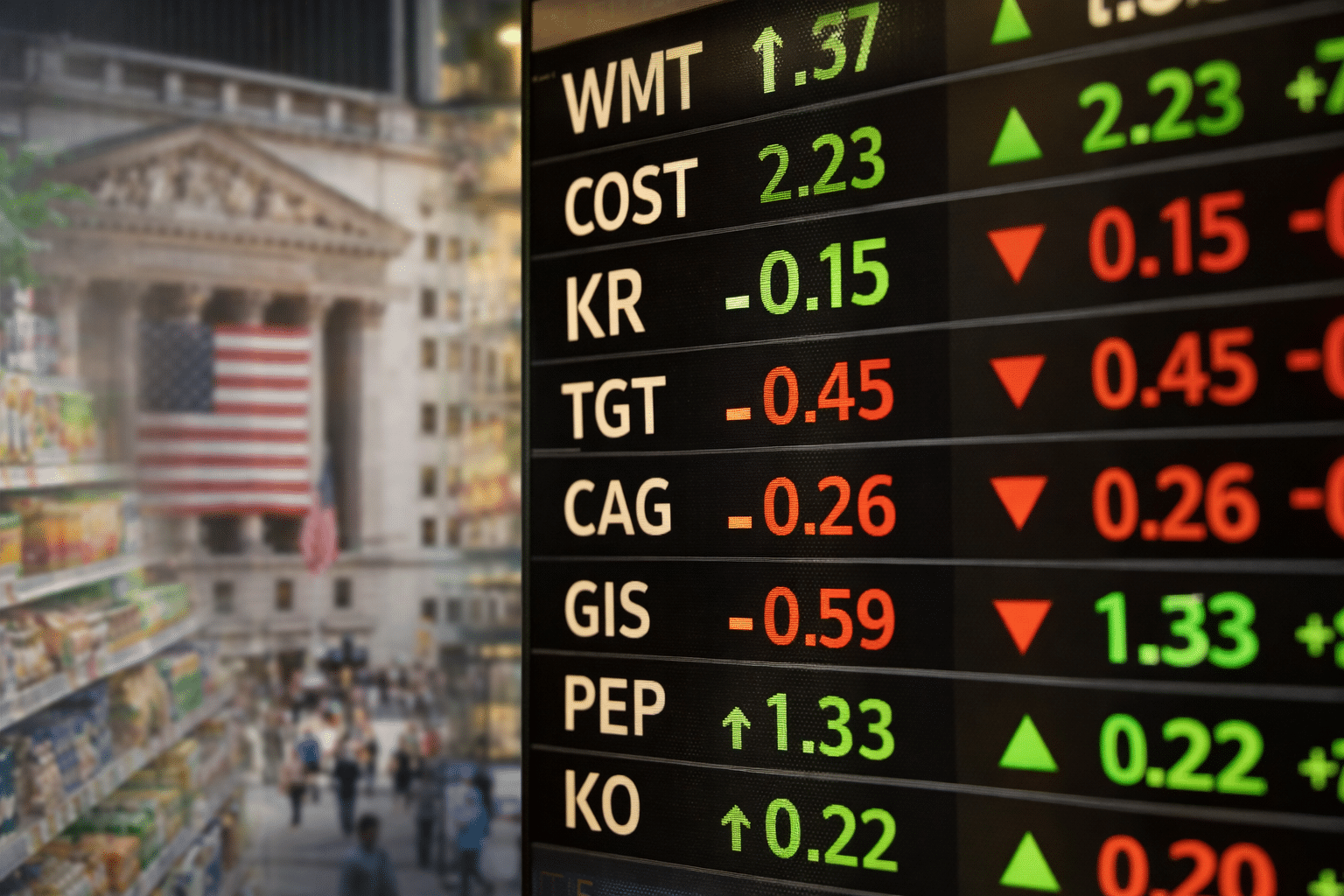
Consumer staples are a classic “defensive” sector for investors wherever uncertainty creeps in around the edges – as it’s doing right now. That’s reflected in the performance of grocery and consumer packaged goods’ (CPG) top 10 stocks over recent weeks.
Indeed, consumer staples like grocery and consumer packaged goods (CPG) have held up better than much of the generally flat broader market in recent weeks. We’ve seen modest gains over one- and three-month windows as investors rotate toward essentials and away from higher-beta names.
Grocery, in particular, continues to trade with lower volatility than most retail categories, reflecting the simple, inescapable reality that people still need to eat regardless of macro noise. But to label this segment just “defensive” is an oversimplification.
Food retail and CPG’s top 10 stocks are no longer being valued purely as safe havens. They’re being repriced around execution, mix, and structural exposure to how consumers are actually behaving right now.
What the Top 10 Stocks in Grocery and CPG Are Telling Investors Right Now
Demand for essentials remains steady, but margin pressure, promotional intensity, and the massive, ongoing private-label trade-down are reshaping how investors look at the sector.
That’s most visible in packaged foods. Companies like Conagra Brands Inc. (NYSE: CAG) and General Mills Inc. (NYSE: GIS) continue to face scrutiny as promotions rise and volumes soften in certain categories.
Cost-conscious shoppers seem willing to substitute, downsize, or switch to store brands, and the market is increasingly sensitive to how much pricing power branded manufacturers truly have left.
Big box retailers have an entirely different experience: Costco Wholesale Corp. (NASDAQ: COST), Walmart Inc. (NASDAQ: WMT), and Target Corp. (NYSE: TGT) benefit from their scale, private label penetration, and exposure across food, consumables, and discretionary categories. That mix allows them to temper volatility and to offset individual margin pressures elsewhere.
What’s emerging is a more selective view of “defensive.” Grocery is being judged on how cleanly it executes in a value-sensitive environment. It’s being evaluated on how well it manages promotions, how disciplined it is on costs, and how effectively it balances national brands with private label.
For your average investor, food retail and CPG stocks still offer downside protection, but they’re no longer blunt instruments. The market is drawing sharper distinctions between companies that are structurally positioned for today’s shopper and those still relying on old assumptions about pricing power and loyalty.
Grocery and CPG: Top 10 Stocks at a Glance
Our sector snapshot below shows why food retail is behaving more defensively than branded CPG right now.
Retailers with scale, traffic stability, and strong private-label programs are being rewarded for execution and predictability, while packaged-goods names are feeling pressure from promotions, mix shifts, and trade-down behavior.
The market is clearly differentiating between companies that control availability and pricing at the shelf versus those that rely on brand power alone.
In the arena of grocery and CPG stocks, consistency and operational leverage seem to matter more to investors than top-line growth stories.
| Company | Ticker | 1-Month Direction* | What’s Driving It | Food Trade News Take |
| Walmart Inc. | WMT | ↑ Modestly | Defensive rotation; steady grocery traffic; private label strength | Walmart continues to trade as a safe harbor grocer with scale advantages and operational leverage. |
| Costco Wholesale Corp. | COST | ↑ | Strong membership economics; food & consumables resilience | Costco remains the cleanest grocery execution story in public markets. |
| Kroger Co. | KR | → / ↑ | Stable food demand; private label focus offsets margin pressure | Investors view Kroger as steady but execution-dependent in a price-sensitive environment. |
| Target Corp. | TGT | → | Grocery stability offsets discretionary softness | Grocery remains a ballast, but Target’s mixed basket tempers enthusiasm. |
| Sprouts Farmers Market Inc. | SFM | ↓ | Specialty exposure; valuation reset after strong run | Health-focused retail is still attractive — but expectations have tightened. |
| Conagra Brands Inc. | CAG | ↓ | Promotional pressure; private label trade-down | Branded center-store foods remain under margin and volume scrutiny. |
| General Mills Inc. | GIS | ↓ | Pricing power questions; volume softness | GIS reflects the broader challenge facing legacy packaged foods. |
| PepsiCo Inc. | PEP | → | Diversified snacks & beverages smooth volatility | Diversification still matters — PEP trades as a hybrid staple. |
| Coca-Cola Co. | KO | → / ↑ | Defensive inflows; pricing discipline | KO benefits from staples rotation but lacks grocery-specific upside. |
| Estee Lauder Cos. Inc. | EL | ↑ | Sentiment rebound; earnings revisions | Not grocery, but useful as a consumer confidence barometer. |


